
- June 19, 2026
- Posted by: Ejike Nwafor
- Categories: Articles, blog, Publications
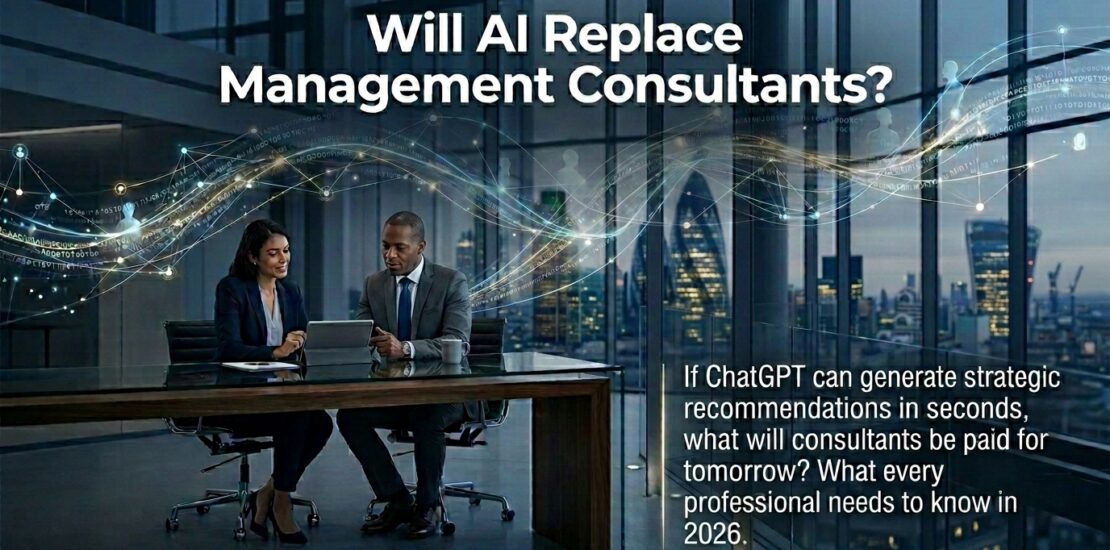
Will AI Replace Management Consultants? What Every Consultant Needs to Know in 2026
If ChatGPT can generate strategic recommendations in seconds, what will management consultants be paid for tomorrow?
In this period of time where Generative AI can scan large datasets, generate comprehensive reports and presentations, conduct deep market research, and automate administrative consulting tasks, there is a growing concern among professionals in the field: Will AI eventually replace management consultants?
The short answer is no. However, AI will fundamentally redefine consulting work, business models, and the required competencies that clients expect. Modern AI in management consulting is shifting rapidly, and recognizing this digital transformation is the first step toward evolution.
Why People Think AI Will Replace Consultants
To understand the anxiety surrounding AI in management consulting, we must first look at the technology’s incredibly rapid progress. In just a few short years, the capabilities of artificial intelligence have expanded from simple data sorting to highly sophisticated cognitive tasks that once defined the value proposition of a traditional analyst.
Research
AI can now scan thousands of documents in mere moments. It can summarize complex industry reports, analyze competitors with precision, and identify subtle market trends that might take human analysts weeks to compile. The ability to parse through endless pages of unstructured data and deliver a concise, actionable brief is no longer a uniquely human trait.
Data Analysis
When it comes to data analysis, AI algorithms can detect hidden patterns in financial models or consumer behaviors. They can generate robust forecasts, build interactive dashboards, and produce predictive insights that guide corporate strategy. This analytical prowess is fundamentally shifting the consulting industry trends.
Content Creation
Furthermore, AI excels in professional content creation. It can draft initial reports, prepare persuasive proposals, create structured PowerPoint slides, and write executive summaries that are largely indistinguishable from those written by associates.
Process Automation
Finally, AI tools for consultants are handling the operational overhead effortlessly. From scheduling meetings and generating meeting minutes to automating entire workflows, AI eliminates the busywork of modern engagements.
Key Message: Many traditional consulting tasks—particularly those involving information gathering and basic synthesis—are becoming partially, if not entirely, automated.
What AI Can Already Do Better Than Many Consultants
The traditional strategy consulting model relied heavily on the “information advantage.” Consultants generally had access to data, proprietary frameworks, and structured time that clients did not. Today, that advantage is shrinking rapidly. AI already outperforms humans in several key domains:
Speed
Consider the preparation of a comprehensive market overview. For a human team, this task might take dozens of hours or even days of concerted effort. For generative AI, it takes seconds or minutes. Speed to insight is dramatically accelerating, placing human consultants at a significant disadvantage in tasks purely dependent on processing time.
Data Processing
AI can review complex financial reports, vast research databases, endless customer feedback logs, and survey responses at a scale completely impossible for humans. Where a management consultant might sample a few hundred survey responses to gauge baseline sentiment, AI can process millions, ensuring that no nuance is lost in aggregation.
Consistency
Unlike a human workforce, AI never gets tired. It does not suffer from cognitive fatigue late on a Friday afternoon. It applies rules with absolute, unwavering consistency and significantly reduces human error in data transcription, calculation, and formatting.
Cost Efficiency
Organizations can now access high-level insights at a significantly lower cost. Why pay premium consulting firm fees for data aggregation when an internal AI tool can achieve similar synthesis for a fraction of the price?
Key Takeaway: The exclusive “information advantage” consultants once enjoyed is shrinking rapidly. To survive, consulting careers must pivot away from sheer data processing.
What AI Cannot Replace
This brings us to the heart of the matter: consulting is not merely information processing. It is deeply human, contextual, and relational. Here is why the high-end human-centered consulting model will remain indispensable:
Trust Building
At its core, clients buy trust. When a CEO is facing an existential threat to their business, they do not turn to a server rack for reassurance. They turn to a trusted advisor.
- Who does the CEO trust to understand their specific vulnerabilities?
- Who can facilitate difficult, emotionally charged conversations in the boardroom?
- Who can actively manage stakeholder resistance during a traumatic restructuring?
AI cannot build deep executive relationships. It cannot look a nervous founder in the eye and say, “We have navigated this before, and here is exactly how we will get through it.”
Political Navigation
Organizations are complex political systems. Consultants often spend a significant portion of their time resolving conflicts, negotiating competing interests, building consensus across siloed departments, and managing intricate power dynamics. AI lacks contextual judgment. It cannot “read the room” to recognize underlying tensions during a steering committee meeting.
Change Management
A classic consulting truism is that even perfect solutions fail if people reject them. You can use AI to design the most mathematically optimized supply chain, but if the warehouse staff refuses to adopt the new protocols, the project fails. Consultants help gain buy-in, train staff, manage resistance, and lead genuine organizational transformation. Humans influence people; AI does not.
Ethical Judgment
Business decisions rarely exist in a vacuum. They involve complex values, significant trade-offs, social impacts, and reputation risks. AI provides generated options based on optimized metrics, but it does not carry accountability. Ethical judgment is an inherently human domain.
Contextual Decision-Making
AI operates largely on patterns and training data. Strategic consulting, however, requires an understanding of culture, personal relationships, organizational history, and hidden constraints that are rarely documented. A human consultant recognizes nuances that a machine simply skips.
How Leading Consulting Firms Are Responding
The world’s premier consulting firm owners and partnerships understand this massive paradigm shift. Instead of fighting it, they are aggressively integrating AI into their core operational models.
Major firms like McKinsey & Company, Boston Consulting Group (BCG), Bain & Company, and Accenture have rolled out:
- AI-powered consulting platforms
- Internal AI assistants designed securely for their ranks
- Automated knowledge management systems
- AI-enhanced research systems
Key Message: The leading firms are not fighting AI. They are actively integrating AI to augment their talent, allowing consultants to focus more on human connections rather than data aggregation.
The Consulting Skills That Will Become More Valuable
As the landscape shifts, the management consultant skills required for success are evolving. To thrive, professionals must lean into these specific areas:
1. Strategic Thinking
Clients no longer need information; they are drowning in it. What they need is interpretation and strategic foresight.
2. Problem Structuring
Defining the right problem remains a distinctly human strength. Structuring the ambiguity before an AI processes anything is where critical value is created.
3. Facilitation
Leading workshops, managing complex stakeholders, and building consensus across fragmented organizations are tasks that require emotional nuance and real-time adaptability.
4. Emotional Intelligence
Understanding human fears, recognizing underlying motivations, and deciphering the unwritten rules of organizational culture represent the highest tier of human-centered consulting.
5. Industry Expertise
Generalist consulting is becoming harder to defend. Specialization is vastly more important. Expertise in specialized fields like Healthcare consulting, Supply chain consulting, Financial services consulting, ESG consulting, and AI governance will be heavily sought after.
6. AI Literacy
Consultants must learn prompt engineering, understand AI governance, and master AI strategy to guide their clients through digital adoption securely.
New Opportunities Created by AI
Rather than solely eliminating previous workstreams, AI is creating entirely new markets and business channels for ambitious consultants.
- AI Readiness Assessments: Helping legacy organizations evaluate their infrastructure to prepare for AI adoption.
- AI Governance Consulting: Establishing the ethical policies, security frameworks, and controls necessary to safely operate AI.
- AI Risk Management: Addressing the labyrinth of intellectual property and compliance concerns.
- AI Transformation Programs: Providing end-to-end AI implementation support, from strategy to vendor selection.
- Workforce Reskilling: Guiding HR departments and leadership through the complex process of helping their workforce adapt.
The Future Consultant: Human + AI
We are witnessing the death of the old consulting model and the rapid birth of a new image.
- Old Model: Consultant + PowerPoint (Manual research and static presentations).
- Current Model: Consultant + Data Analytics (Big data, complex dashboards, and quantitative modeling).
- Emerging Model: Consultant + AI + Human Judgment
The most successful consultants of tomorrow will become AI-augmented professionals. They will utilize Generative AI to do the heavy lifting of research, freeing them to spend the vast majority of their time on the human elements of strategy, relationship building, and change management.
Five Practical Actions Consultants Should Take Today
To secure your consulting career, take these actionable steps:
- Learn AI tools daily: Experiment with new generative tools. Understand what they can do and their limitations.
- Develop a niche specialization: Become the undisputed expert in a specific industry or critical function.
- Strengthen facilitation skills: Invest heavily in your ability to run workshops, guide difficult conversations, and align teams.
- Invest in change management expertise: Understanding the psychology of organizational change will become your most critical differentiator.
- Build thought leadership: Do not just consume. Publish articles, original research, case studies, and professional insights.
In Conclusion
Will AI eventually replace management consultants?
The evidence suggests it will not. A much more accurate and urgent statement is: Consultants who use AI will replace consultants who do not.
The future belongs not to professionals who stubbornly compete against AI on processing speed, but to those who learn how to seamlessly collaborate with it to create unprecedented, uniquely human value for their clients.
What to do next:
Start asking and looking for answers to these questions:
How is AI currently changing your consulting practice? What new competencies should every Certified Management Consultant (CMC) prioritize in their development plan? How can the consulting profession remain brilliantly relevant in the age of intelligent machines?
Join the conversation and start building your AI-augmented future today.
Click here TO JOIN IMC NIGERIA and BECOME A CERTIFIED MANAGEMENT CONSULTANT