
Consultant Bias: How Bias Can Distort Management Consulting Advice
- October 5, 2026
- Posted by: Ejike Nwafor
- Categories: Articles, blog, Publications
Consultant Bias: How Bias Can Distort Management Consulting Advice
A practical guide to recognising cognitive, client and commercial bias—and protecting objectivity in management consulting
By Ejike Nwafor, FIMC, CMC
A business engages a management consultant because it wants something it may struggle to provide internally: an informed, experienced and sufficiently independent perspective on an important problem.
The expectation is straightforward. The consultant should examine the facts, challenge assumptions, identify the real problem and provide professional advice—even when that advice is uncomfortable.
But there is a question that deserves attention:
Who examines the assumptions of the consultant?
Management consultants are trained to analyse organisations, markets, strategies, systems, people and problems. Yet consultants are also human beings. They bring their own experiences, preferences, professional habits, relationships, incentives and assumptions into every engagement.
The client brings assumptions too. So does the organisation in which the consulting assignment takes place.
This creates a less-discussed professional risk: consultant bias.
Consultant bias does not necessarily mean that a consultant is dishonest, unethical or deliberately misleading a client. Bias can operate without conscious intent. It can influence what a consultant notices, what questions are asked, which evidence receives attention, how a problem is framed and which recommendation ultimately appears most convincing.
For management consultants, therefore, objectivity should not be understood as a personal quality that one either possesses or does not possess.
Objectivity is a professional practice.
It has to be actively protected.
What Is Consultant Bias?
Consultant bias is the influence of personal assumptions, cognitive tendencies, client preferences, commercial interests or other contextual factors on a consultant’s professional judgement.
A consultant may believe that a recommendation is entirely evidence-based while unconsciously giving greater weight to evidence that confirms an existing view.
For example, a consultant who has successfully implemented a particular technology may be more inclined to recommend a similar solution to a new client. The recommendation might genuinely be appropriate—but the consultant should still ask whether the solution is being recommended because it fits the client’s problem or because it fits the consultant’s previous experience.
This is the central issue with bias:
A biased conclusion is not necessarily a false conclusion.
A recommendation can be correct and still have been reached through a biased process.
That distinction is important because professional consulting is not simply about producing an answer. It is about applying a sound process to arrive at an answer that can withstand reasonable scrutiny.
Bias, Error, Conflict of Interest and Misconduct Are Not the Same Thing
These concepts are often treated as though they mean the same thing. They do not. Let’s look at them closely:
| Concept | Meaning | Example |
|---|---|---|
| Bias | A tendency that can influence judgement | Preferring a familiar technology because of previous experience |
| Error | A mistake in reasoning, evidence or execution | Misinterpreting financial data |
| Conflict of interest | A situation in which another interest may influence, or appear capable of influencing, professional judgement | Recommending a vendor from which the consultant receives a commission |
| Misconduct | Behaviour that violates professional, ethical, contractual or legal obligations | Concealing a relevant financial interest from the client |
From the concept definitions, it follows that Bias can exist without misconduct.
However, when a bias is connected to a financial interest, undisclosed relationship, competing engagement or other material interest, the matter may become a conflict of interest.
That is why professional consultants need mechanisms for identifying, testing and managing bias rather than simply assuming that good intentions are enough.
Why Consultant Bias Matters
Consulting recommendations can influence major organisational decisions, like:
- corporate strategy;
- restructuring;
- recruitment and workforce decisions;
- technology investments;
- digital transformation;
- marketing strategy;
- procurement;
- financial priorities;
- organisational design;
- mergers and acquisitions;
- public-sector programmes;
- risk management;
- business process redesign.
The consequences can therefore extend well beyond the consulting report.
If the diagnosis is distorted, the recommendation may solve the wrong problem.
If the evidence is selectively interpreted, management may make an expensive decision on an incomplete picture.
If commercial interests influence the recommendation without proper disclosure, trust in the consultant—and potentially in the profession itself—can suffer.
This is why professional consulting standards place such emphasis on independence and objectivity.
IMC Nigeria’s Code of Professional Conduct requires consultants to serve clients with integrity, competence, independence, objectivity and professionalism. It also calls for evidence-based advice and requires disclosure of circumstances or interests capable of influencing professional judgement or objectivity.
The international CMC framework similarly identifies impartiality and objectivity as professional competencies and expects consultants to identify and handle bias or doubts about objectivity.
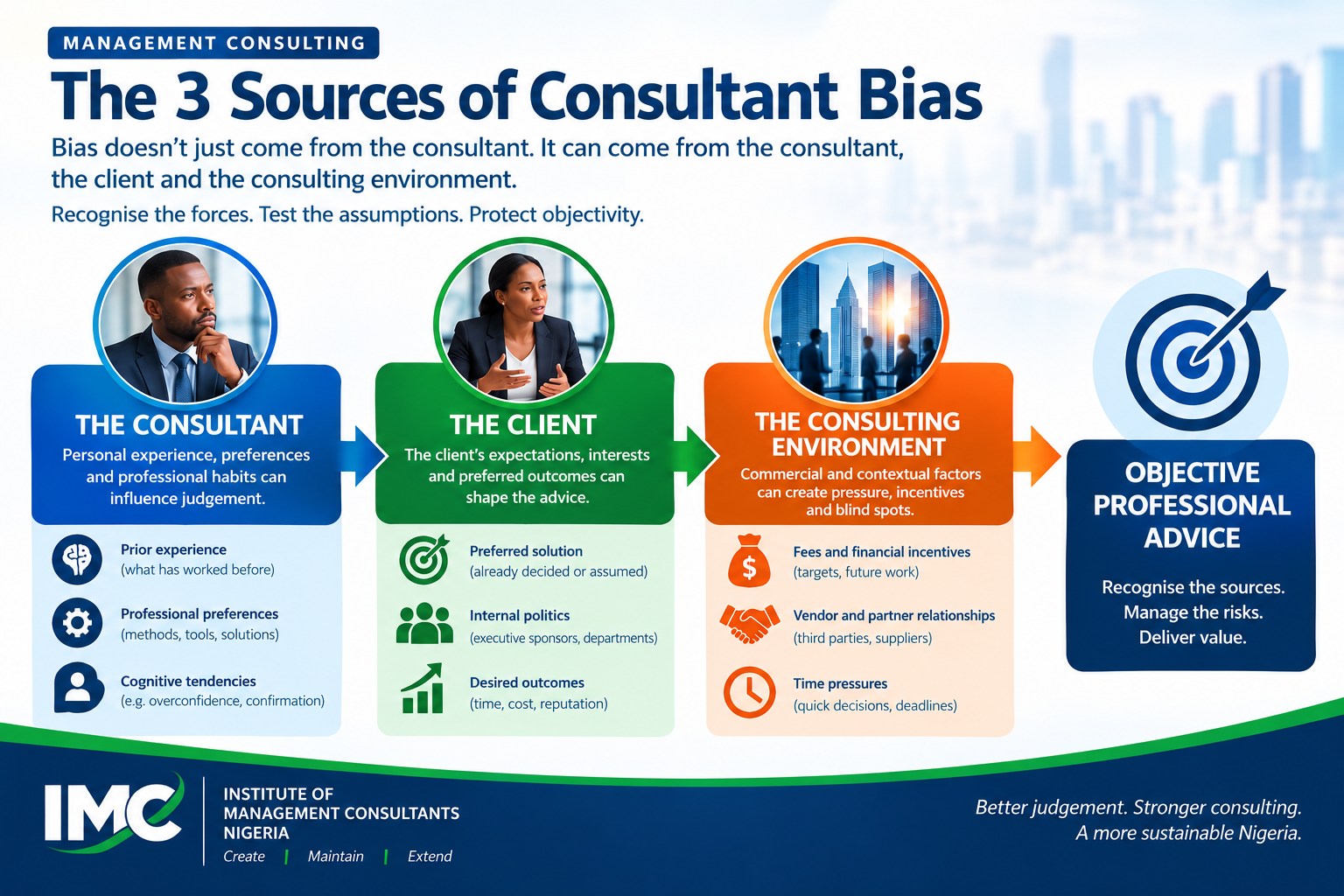
The Three Sources of Consultant Bias
One of the most useful ways to understand consultant bias is to recognise that it does not originate only in the consultant.
It can come from three directions:
1. The Consultant
The consultant brings personal experience, professional preferences, assumptions, expertise and cognitive shortcuts.
2. The Client
The client may already have a preferred explanation, solution, executive sponsor, internal political position or desired outcome.
3. The Consulting Environment
Commercial incentives, relationships, fees, previous engagements, vendor relationships, organisational politics and time pressures can influence the consulting process.
These three sources can interact.
A client may strongly prefer a particular solution. The consultant may have experience with that solution. A vendor may also have a commercial relationship with the consultant.
At that point, several reinforcing forces can push the engagement in the same direction.
The professional challenge is to recognise those forces before they become invisible assumptions.
1. Bias From the Consultant
Every consultant has a professional history.
That experience is valuable. It is one of the reasons clients hire consultants.
But experience can also become a source of bias.
A consultant who has spent twenty years working with large organisations may instinctively apply large-enterprise solutions to smaller businesses.
A technology consultant may see a technology problem where the real problem is process or people.
A marketing consultant may interpret declining sales primarily through a marketing lens when pricing, distribution or product quality is actually responsible.
An experienced consultant can therefore be both more knowledgeable and more vulnerable to certain forms of professional bias.
Experience creates patterns.
Patterns can make diagnosis faster.
But patterns can also make the consultant see what they expect to see.
Recent research specifically examining strategy consultants found that analytical and intuitive modes of cognition can both play important roles in consulting, with greater experience associated with increased reliance on intuition. That does not make intuition inherently bad; it highlights why experienced consultants still need mechanisms for testing professional judgement.
2. Bias From the Client
Sometimes the consultant is not the person who introduces the bias into the engagement.
The client may already have decided what the problem is.
Consider a chief executive who says:
“Our sales team is the problem. We need a new sales strategy.”
The consultant now faces a critical professional choice.
Should the engagement begin by accepting that diagnosis?
Or should the consultant investigate whether the underlying issue is actually:
- product-market fit;
- pricing;
- distribution;
- customer experience;
- competitive pressure;
- sales incentives;
- leadership;
- brand positioning;
- economic conditions?
The client’s initial description is valuable information.
But it is not necessarily the final diagnosis.
A professional consultant must be willing to distinguish between:
the problem the client reports
and
the problem the evidence reveals.
This is one of the most important safeguards against consultant bias.
3. Bias From the Consulting Environment
The third source is often the most uncomfortable because it involves incentives.
Consultants operate businesses.
They have fees, targets, relationships, teams, suppliers, partners and future opportunities.
These commercial realities do not automatically make consulting advice biased.
But they create circumstances that should be recognised.
Imagine a consultant recommending:
- a technology platform supplied by a business partner;
- additional consulting work that the consultant’s own firm would deliver;
- a service in which the consultant has a financial interest;
- a vendor from whom the consultant receives a commission.
The recommendation might still be the best option.
But the relevant interest should not remain hidden.
IMC Nigeria’s Code specifically addresses third-party commissions, remuneration and financial interests connected with recommendations to clients. It also requires consultants to avoid conflicts of interest—or the appearance of such conflicts—and to offer to withdraw where objectivity or integrity may be impaired.
The principle is simple:
A consultant should not merely be objective; the circumstances surrounding the recommendation should support reasonable confidence in that objectivity.
CLICK HERE TO JOIN IMC NIGERIA,
DELIVER VALUE TO CLIENTS AND GAIN GLOBAL PROFESSIONAL BACKING
Cognitive Biases That Can Affect Management Consultants
Consultants are not immune from the cognitive biases that affect other decision-makers.
Several are particularly relevant to consulting.
1. Confirmation Bias
Confirmation bias occurs when people give disproportionate attention to information that supports an existing belief while discounting information that challenges it.
A consultant may form an early hypothesis and then unconsciously search for evidence that confirms it.
Example
A consultant suspects that poor customer service is causing customer losses.
Interviews with dissatisfied customers reinforce the hypothesis.
But the consultant pays less attention to evidence showing that competitors are winning primarily because they offer substantially lower prices.
Professional safeguard
Ask:
“What evidence would prove our current hypothesis wrong?”
That question forces the investigation to look beyond confirmation.
2. Anchoring Bias
Anchoring occurs when an initial figure, assumption or interpretation exerts too much influence on subsequent judgement.
In consulting, the anchor might be:
- the client’s initial estimate;
- a previous consultant’s report;
- a historical budget;
- a proposed project cost;
- an executive’s initial diagnosis;
- an industry benchmark.
Once established, the anchor can unconsciously shape subsequent analysis.
Professional safeguard
Where practical, develop an independent baseline before allowing the initial figure to dominate the analysis.
3. Overconfidence Bias
Consultants are hired for expertise.
That can create an understandable—but dangerous—temptation to become overly confident in one’s judgement.
A consultant may believe that years of experience make a particular outcome obvious.
But complex organisational systems rarely behave exactly like previous cases.
Professional safeguard
Distinguish between:
“I have seen this before.”
and
“I have established that this is the same problem.”
Those are not equivalent statements.
4. Availability Bias
People tend to give greater weight to information that is particularly recent, memorable or easily recalled.
A consultant who recently completed a successful artificial intelligence transformation, for example, may overestimate the relevance of AI to a new client’s problem.
The consultant’s recent experience is highly available in memory.
That does not make it irrelevant.
It simply means it should be tested against the client’s actual evidence.
5. Status Quo Bias
Consultants can also become attached to existing organisational arrangements.
Sometimes the bias is toward change:
“The organisation needs transformation.”
Sometimes it is toward preservation:
“The existing system works well enough.”
Neither position should be assumed.
The professional question is:
What does the evidence justify?
6. Sunk-Cost and Escalation Bias
Once significant time and effort have been invested in a particular recommendation, consultants may become reluctant to abandon it.
A project can therefore continue moving in the wrong direction simply because too much has already been invested.
This is particularly relevant to technology, transformation and organisational change projects.
Professional safeguard
Build formal review points into significant engagements.
At each review point, ask:
“Knowing what we know now, would we still recommend starting this project today?”
If the answer is no, the engagement may need to change direction.
7. Authority Bias
Consultants may be influenced by senior executives, respected experts or influential stakeholders.
A CEO’s opinion may carry more weight than the evidence deserves simply because the CEO expressed it.
The same can happen in reverse: management may accept a consultant’s recommendation simply because the consultant is perceived as an expert.
Professional authority should strengthen analysis—not replace it.
8. Framing Bias
The way a problem is presented can influence how it is interpreted.
Consider two descriptions:
“Our employees are resisting digital transformation.”
versus:
“Our employees may not yet have the capability, incentives or confidence required to adopt the new system.”
The first framing places the problem primarily on employees.
The second invites investigation into organisational capability and change management.
The consultant’s first task may therefore be to examine the frame itself.
The Problem Definition May Be the First Bias
This deserves special attention.
Consultants are often taught to solve problems efficiently.
But a poorly defined problem can make efficient problem-solving dangerous.
If the problem is wrong, a technically excellent solution may simply solve the wrong problem very efficiently.
Consider:
“How can we increase website traffic?”
That sounds like a digital marketing problem.
But perhaps the real issue is that the organisation is attracting traffic but converting very few visitors into customers.
Or perhaps customers are purchasing once and never returning.
The correct consulting question may therefore be:
“What business outcome are we actually trying to improve?”
Only after that question has been answered should the consultant determine which analytical problem needs to be solved.
What Happens When the Client Has Already Decided the Answer?
One of the most difficult consulting situations occurs when the client hires a consultant primarily to validate an existing decision.
The client may say:
“We have decided to implement this solution. We just need your report.”
This creates a professional dilemma.
There may be nothing inherently wrong with being asked to evaluate or document a decision.
The problem arises when the consultant is expected to present a predetermined conclusion as though it emerged independently from objective analysis.
A consultant should be able to say:
“We will test the proposed solution against the evidence.”
That is fundamentally different from:
“We will find evidence to support the proposed solution.”
The distinction is subtle, but professionally significant.
When Consultant Bias Becomes a Conflict of Interest
Not every bias constitutes a conflict of interest.
A consultant’s preference for one analytical method over another is not automatically a conflict.
But where an external interest can influence—or reasonably appear capable of influencing—professional judgement, the issue becomes more serious.
Examples include:
- financial interests in recommended products or services;
- undisclosed commissions;
- relationships with vendors;
- simultaneous engagements with competing clients;
- personal relationships affecting professional judgement;
- ownership interests in a recommended business;
- incentives to expand the scope of an engagement;
- pressure to secure future work;
- personal interests connected to the client’s decision.
IMC Nigeria’s professional code requires consultants to disclose circumstances or interests that may reasonably be regarded as capable of influencing judgement or objectivity. It also provides that consultants should offer to withdraw when objectivity or integrity may be impaired.
ICMCI’s international CMC Code similarly requires consultants to consider actual or perceived conflicts of interest and to act independently and objectively.
The important principle is therefore not simply:
“I know I can remain objective.”
It is also:
“Would a reasonable client have sufficient information to trust the circumstances in which this recommendation was produced?”
Consultant Bias in the Nigerian Context
The underlying principles of consultant objectivity are universal, but the consulting environment in Nigeria can introduce particular contextual pressures.
These may include:
Hierarchical decision-making
Junior employees may hesitate to contradict senior executives.
A consultant should therefore be cautious about treating the opinion of the most senior person in the room as automatically representative of the organisation.
Organisational politics
Different executives, departments or stakeholder groups may have competing interests.
The consultant may hear several versions of the “real problem.”
The professional response is not to choose the most powerful stakeholder’s version automatically, but to establish the facts and understand the interests involved.
Procurement and vendor relationships
Technology, infrastructure and other consulting recommendations may involve vendors, implementation partners or third-party service providers.
Where financial or commercial relationships exist, transparency becomes particularly important.
Public-sector and institutional consulting
Consultants working with government institutions, agencies and other public-interest organisations may encounter a wider range of stakeholders and accountability requirements.
The consultant must consider not only the immediate request but also the professional, legal and public-interest implications of the advice.
Imported solutions and local realities
A solution that worked in another country, industry or organisation may not automatically work in Nigeria.
International best practice should inform professional judgement—not replace local diagnosis.
The real question is not:
“Has this worked elsewhere?”
It is:
“Does the evidence show that this is appropriate here?”
Can a Management Consultant Ever Be Completely Objective?
Probably not in the sense of having no assumptions, preferences or prior experiences.
But that is not the professional standard that matters most.
The more useful question is:
Can the consultant recognise factors that may distort judgement and put reasonable safeguards around them?
This leads to an important principle:
Objectivity is a practice, not a personality trait.
A consultant protects objectivity through process.
That process may include:
- defining the problem carefully;
- testing assumptions;
- gathering evidence from multiple sources;
- seeking contradictory evidence;
- separating facts from interpretations;
- considering alternative explanations;
- disclosing relevant interests;
- using independent review;
- documenting major analytical decisions;
- challenging the client’s preferred conclusion;
- revisiting recommendations when new evidence emerges.
This approach does not eliminate human judgement.
It makes that judgement more disciplined.
How Consultants Can Reduce Bias
Before the Engagement
Before accepting an assignment, ask:
- Do I have the competence required?
- Are there existing relationships that could affect independence?
- Are there actual or perceived conflicts of interest?
- Do I have financial interests connected to the assignment?
- Are the client’s expectations realistic?
- Is the scope sufficiently clear?
Professional standards reinforce these precautions. IMC Nigeria requires consultants to accept only assignments for which they possess the requisite competence and to establish a mutual understanding of objectives, scope, work plan and fees before an engagement begins.
During Problem Definition
Ask:
- Who defined the problem?
- What evidence supports the current diagnosis?
- What assumptions are embedded in the problem statement?
- What alternative explanations exist?
- What would we investigate if the client’s preferred diagnosis were wrong?
This stage can prevent significant downstream errors.
During Evidence Gathering
Use multiple sources where practical.
For example:
- management interviews;
- employee interviews;
- customer feedback;
- financial information;
- operational data;
- market research;
- process observation;
- competitor analysis;
- independent industry evidence.
The objective is not to collect information indefinitely.
It is to avoid allowing one perspective to become the entire reality.
During Analysis
Separate:
Facts
from
Interpretations
and from
Assumptions.
A statement such as:
“Customers are leaving because of poor service.”
should not automatically be treated as a fact simply because several managers believe it.
It may be a hypothesis requiring evidence.
During Recommendation Development
Before recommending a solution, ask:
- What alternatives did we consider?
- Why were they rejected?
- What evidence supports the preferred option?
- What evidence contradicts it?
- What assumptions must be true for this recommendation to work?
- What are the risks?
- Who benefits?
- Who may be disadvantaged?
- What would make us change our recommendation?
The final question is particularly powerful.
If there is no conceivable evidence that would cause the consultant to change the recommendation, the consultant may have moved from analysis into advocacy.
The Consultant Bias Test
Before finalising a major recommendation, a consultant can use this simple test.
1. What assumptions are we making?
List them explicitly.
2. What evidence contradicts our conclusion?
Do not look only for confirming evidence.
3. What alternative explanations have we considered?
A good diagnosis should survive comparison with credible alternatives.
4. Whose interests benefit from this recommendation?
The answer should be transparent.
5. What information would change our conclusion?
If the answer is “nothing,” reconsider whether the analysis remains genuinely open.
6. Have we confused the client’s preferred solution with the client’s actual problem?
These are often very different.
7. Would we give the same advice if there were no commercial incentive attached to the outcome?
This is an especially useful test where vendors, commissions or future engagements are involved.
8. Would we be comfortable defending this recommendation to an independent professional reviewer?
If not, something may need further examination.
What Professional Ethics Requires
Ethical consulting is not simply about avoiding obvious misconduct.
It is about creating the conditions in which professional judgement can be trusted.
IMC Nigeria’s Code of Professional Conduct places independence and objectivity alongside integrity, competence and professionalism. It also requires evidence-based advice and directs consultants to disclose relevant conflicts and withdraw where objectivity or integrity may be impaired.
The international CMC Code similarly identifies independence, objectivity, integrity, transparency and professional care as core qualities of professional consulting.
The ICMCI competence framework goes further by treating impartiality and objectivity as competencies that consultants should actively understand and apply, including identifying and handling bias or doubts about objectivity.
This is significant.
Professionalism is not merely about knowing what is right.
It is also about establishing practices that make it more likely that the right thing will be done when commercial, organisational or psychological pressures appear.
The Responsibility of the Management Consulting Profession
The responsibility does not rest entirely with individual consultants.
Consulting firms and professional bodies also have an important role.
Firms can support objectivity through:
- conflict-of-interest procedures;
- peer review;
- independent quality assurance;
- ethical training;
- clear disclosure policies;
- documented methodologies;
- supervision and mentoring;
- engagement review processes;
- appropriate escalation mechanisms.
ICMCI’s CMC-Firm framework specifically considers areas such as commitment to professional codes, ethical training, conflict avoidance, objectivity and withdrawal where a consultant’s integrity or objectivity may be impaired.
Professional bodies likewise have a role in developing standards, training consultants and strengthening public confidence in the profession.
This aligns with IMC Nigeria’s stated objectives of improving professional performance, encouraging the training and development of Nigerian consultants and enhancing the reputation of management consulting as a profession.
For Aspiring Management Consultants
If you are considering a career in management consulting, learning analytical tools is important.
So are communication, research, presentation, financial understanding, technology, strategy and problem-solving skills.
But there is another capability that is sometimes overlooked:
the ability to question your own thinking.
A good consultant should be comfortable saying:
“I may be wrong.”
That is not weakness.
It is intellectual discipline.
The strongest consultants do not merely know how to convince clients.
They know how to test their own conclusions before asking clients to trust them.
For anyone considering becoming a professional management consultant in Nigeria, this mindset is particularly important. Professional consulting is ultimately built not only on technical competence but also on trust, integrity and the quality of judgement brought to client problems.
For Organisations Hiring Consultants
The responsibility also belongs to clients.
A client should not hire a consultant merely because the consultant is willing to confirm management’s preferred conclusion.
When selecting a consultant, organisations should consider asking:
- How will you establish the actual problem?
- How will you challenge our assumptions?
- How do you identify conflicts of interest?
- What happens when your findings contradict management’s expectations?
- How do you validate major recommendations?
- What evidence will support your conclusions?
- What would cause you to change your recommendation?
These questions do not make the consulting relationship adversarial.
They make it professional.
A consultant who welcomes these questions is often more useful than one who promises certainty from the beginning.
Frequently Asked Questions About Consultant Bias
What is consultant bias?
Consultant bias is the influence of personal assumptions, cognitive tendencies, client preferences, commercial interests or other contextual factors on a consultant’s professional judgement.
Is consultant bias always unethical?
No. Bias can be unconscious and does not automatically constitute misconduct. However, consultants have a professional responsibility to recognise and manage factors that could compromise—or appear to compromise—their objectivity.
What is cognitive bias in management consulting?
Cognitive bias in management consulting refers to systematic tendencies in human judgement that can affect how consultants interpret information, evaluate alternatives and make recommendations.
What biases affect management consultants?
Examples include confirmation bias, anchoring, overconfidence, availability bias, status quo bias, sunk-cost bias, authority bias and framing bias.
How can management consultants remain objective?
Consultants can strengthen objectivity by testing assumptions, seeking contradictory evidence, considering alternative explanations, using multiple sources of evidence, disclosing relevant interests and obtaining independent review where appropriate.
What is the difference between consultant bias and conflict of interest?
Bias is a tendency that can influence judgement. A conflict of interest arises when another interest may influence—or reasonably appear capable of influencing—professional judgement.
Why is objectivity important in management consulting?
Consultants influence important organisational decisions. Objectivity helps ensure that recommendations are based on evidence, professional judgement and the client’s legitimate interests rather than undisclosed personal or commercial interests.
Can consultants eliminate bias completely?
Probably not. The more realistic professional goal is to recognise potential sources of bias, test conclusions and establish processes that reduce their influence.
What should a consultant do when a conflict of interest exists?
The consultant should identify and disclose the relevant interest, discuss appropriate mitigation with the client and, where objectivity or integrity may be impaired, consider withdrawing from the assignment.
What makes a good management consultant?
A good management consultant combines technical competence with sound judgement, professional independence, evidence-based analysis, communication skills, integrity, objectivity and the willingness to challenge assumptions—including their own.
So in summary: The Consultant Must Examine the Himself
Management consulting depends on trust.
Clients trust consultants with information, problems, decisions and sometimes the future direction of their organisations.
That trust cannot rest on expertise alone.
A consultant can be highly experienced and still be influenced by cognitive bias.
A consultant can be ethical and still have unconscious assumptions.
A consultant can genuinely want to help a client and still be influenced by commercial incentives.
The professional response is not to pretend these influences do not exist.
It is to recognise them.
That is why consultant objectivity should be understood as an active discipline.
Question the assumption.
Test the diagnosis.
Look for contradictory evidence.
Declare relevant interests.
Challenge the client’s preferred answer when the evidence requires it.
Be willing to change your recommendation when the facts change.
And when circumstances make genuine objectivity impossible, have the professional courage to say so.
The strongest consultants are therefore not necessarily those who claim to have no bias.
They are those who know how to challenge their own biases.
About the Author
Ejike Nwafor, FIMC, CMC is an ICT Solutions Consultant and Lecturer of Marketing and ICT, with professional interests spanning digital technology, management consulting, marketing, ICT and professional development.
Professional Reference
This article is informed by professional standards including the IMC Nigeria Code of Professional Conduct and the ICMCI Code of Conduct for Consultants. Readers interested in professional management consulting standards are encouraged to consult the applicable codes directly.
Related IMC Nigeria resources:
- IMC Nigeria Code of Professional Conduct
- Ethics and Professionalism in Management Consulting
- CMC / Certified Management Consultant resources
If you are not yet a member
CLICK HERE TO JOIN IMC NIGERIA
Submit your information and get official invitation